
Cartoonists under pressure
Censorship, threats and self-censorship are on the rise worldwide

Nearly half of the roughly three hundred cartoonists surveyed worldwide have had at least one cartoon removed from a social media platform in recent years. This is one of the key findings of Under Pressure. Report on the Situation of Threatened Cartoonists around the World 2023–2025, published by Cartooning for Peace in partnership with Reporters Without Borders (RSF) and supported by UNESCO’s Global Media Defence Fund.
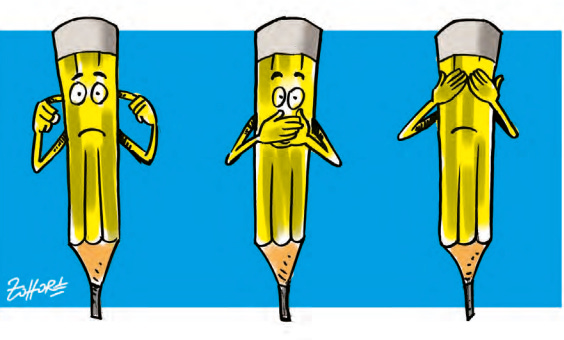
There is pressure from the highest authorities and widespread media vilification. Together, these inevitably lead to self-censorship, writes the French cartoonist Kak, president of Cartooning for Peace. He now sees this “pernicious trifecta” emerging in the United States as well. The year 2025 also marked the tenth anniversary of the attacks on the editorial office of Charlie Hebdo, several of whose staff members still live under police protection. The report calls this a sombre reminder that the threats hanging over cartoonists and their freedom of expression have not disappeared.
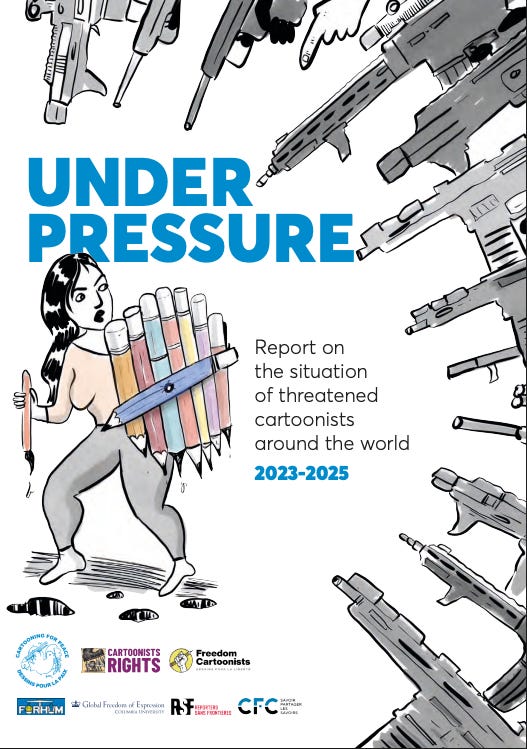
War contexts have a profound impact on cartoonists. Armed conflicts in Ukraine, Sudan and the Democratic Republic of Congo directly threaten their physical safety and endanger their work. Since the Taliban’s return to power in Afghanistan, cartoonists have been forced into hiding and can no longer publish their drawings. In recent years, Cartooning for Peace has documented dozens of cases of threats against cartoonists, as well as twenty-two legal proceedings in countries such as Turkey, India, Malaysia, Egypt and Saudi Arabia.
The painful and absurd fate of Mohammed Al Ghamdi, known by his pseudonym Mohammed Al Hazz, illustrates this repression. Arrested in Saudi Arabia in 2018 for publishing cartoons in the Qatari newspaper Lusail, he was accused of “sympathy for Qatar” at a time when the country was under a Saudi-led economic boycott. Although the blockade was lifted in 2021 and the two countries signed cooperation agreements in 2025, Saudi authorities decided in January 2025 to extend his imprisonment, bringing his total sentence to twenty-three years. “As many cartoonists know, injustice and absurdity often go hand in hand. The disappearance of logic and reason is often the result of the disappearance of freedom,” the report states.
Economic pressures are also taking a heavy toll. As newspapers struggle financially, staff cartoonist positions are disappearing. In Latin America, more than four hundred newspapers have closed over the past decade. In Peru, where around fifteen daily newspapers are published, La República is now the only paper that runs a daily political cartoon. Other newspapers have dismissed their cartoonists.
Many cartoonists have therefore moved online, but there they are vulnerable to the arbitrary decisions of — largely American — technology platforms. Of the three hundred cartoonists surveyed, 43 percent reported having at least one cartoon removed. The most common reasons cited were political content (52 percent), religious sensitivities (19 percent) and alleged hate speech (16 percent). One in five cartoonists experienced a temporary account suspension, while 8 percent saw their accounts permanently closed. In many cases, no explanation was provided.
Cartoonists are also personally exposed. Three quarters reported receiving abusive messages, and 53 percent had been threatened. The main triggers were political positions (74 percent), alleged insults toward political figures (64 percent) and religious reasons (45 percent). One in ten cartoonists had their personal data published online without consent, and two in ten reported that family members were targeted with hostile messages. Female cartoonists, in particular, are disproportionately targeted.
Cartooning for Peace also documented cases in Europe, Canada and the United States where accusations of antisemitism were used to censor cartoons criticizing crimes committed by Israel in Gaza. As Portuguese academic Paulo Jorge Fernandes (Nova University Lisbon) notes: “Confusing criticism of Israel with antisemitism is an increasingly common mistake. It does little to protect Jews, but significantly advances right-wing political agendas in Israel and Palestine.”
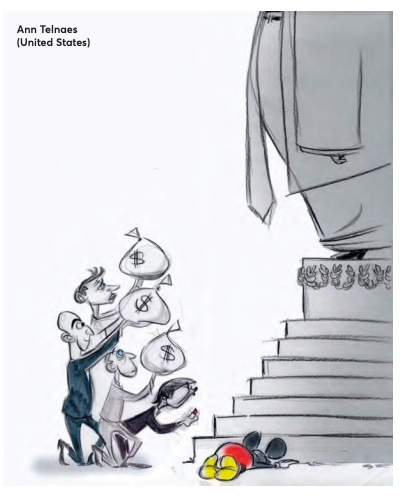
In the United States, freedom of expression itself has become a central political battleground. In 2025, the White House targeted an old cartoon by Feggo displayed at the Smithsonian, addressing migration from Mexico. Ann Telnaes resigned from The Washington Post after the paper refused to publish her cartoon depicting owner Jeff Bezos bowing at the feet of Donald Trump. Pulitzer Prize–winning cartoonist Adam Zyglis received death threats following a critical cartoon about climate policy.
“Autocrats are extremely thin-skinned and hate being ridiculed. Above all, they fear the corrosive power of satire, which exposes the emperor’s nakedness. But they don’t need to pick up the phone to give instructions. When fear takes hold, censorship is no longer even necessary; self-censorship does the job for them. Today, fear has taken hold in the United States,” writes Patrick Chappatte, president of the Freedom Cartoonists Foundation.
As Kak conclude: “Even in this gigantic democracy, this empire of dessins de presse, which for many years had the largest number of cartoonists in the world, the sector is in rapid decline. It’s a serious warning for Europe: will the Old Continent, the cradle of satirical cartoons in the 18th century, go down the same path or, on the contrary, will it take up the torch as the global beacon of cartoons, critical thinking, and freedom of speech?”
Thanks for sharing your reflection, Peter! It’s a very interesting topic in the current context of increasing pressure on journalists and media professionals. Cartoonists, who have historically provided one of the most incisive forms of political and social commentary, are often on the front line of the tension between freedom of expression, censorship and threats. Reports like this help make visible how the space for satire and graphic criticism is narrowing in many parts of the world.